
Mo Ghra Labrador
This is our passion thus we do our very best in every way!


Play Theroy
Play is fun but can also be used to be educational as well
key training strategies
Kennel - Safe space not a time out
Classical Conditioning – shape positive associations
Operant Conditioning – Voluntary behavior shaped by consequences
Positive Reinforcement / Force free - Reward
Negative Reinforcement - Remove
Counter-Conditioning - planed engagement
Shaping - baby steps
Canine-Responsive Practice: Prioritizing the individual dog's emotional state and personality over rigid "one-size-fits-all" standards.
Family-Centric Training: The philosophy that for training to be successful, the entire family must be active participants to ensure consistency in communication.
Learning can be fun
Key Training Strategies
Kennel theory focuses on establishing the facility or crate as a "safe haven" rather than a place of confinement. Training typically revolves around:
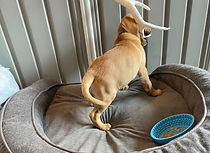
The "Den" Concept: Many theories treat the kennel as a substitute for a natural den where dogs can instinctively relax and feel secure. this can also help with house training as dogs will not soil their den on purpose thus this can be used to our advantage. we like the rule of for every 2 weeks of life is an hour of time in the kennel, you just brought an 8-week-old puppy home that is up to 4 hours of kennel time before a bathroom break is needed. but never longer than 8 hours if you can't hold it then they shouldn't have to.
Safety and Security: Preventing destructive behaviors, ingestion of foreign objects, and providing a controlled environment during unsupervised times. this can also prevent an emergency visit to a vet as well
Behavioral Stability: reduce separation anxiety and manage over-stimulation.
Predictability and Routine: Establishing a consistent schedule for feeding, exercise, and rest to lower a dog’s stress levels.
Getting the right reward for your dog is crucial for us its food for most labradors respond very well to food rewards!
Baby steps is key to keep from getting frustrated for both you and your dog.
-
Handfeeding & Luring: Offer meals directly from your hand to build a bond or use kibble in a closed hand to lure the puppy, teaching them to follow your hand and associate you with food. Using their daily kibble allowance to reward obedience, calm behavior, and engagement. Implement a "nothing in life is free" approach by requiring a sit or wait before releasing them to eat, which builds focus and prevents guarding.
-
"Place" and "Wait" Exercises: Have the puppy sit on a "place" (like a rug or bed) while preparing food. Lower the bowl slowly; if the puppy dives for it, lift it back up. Only release the puppy with a command (e.g., "okay" or "break") once they look at you calmly.
-
No Free-Feeding: Establish a routine by placing the food down for 10–15 minutes. If the puppy does not eat, pick it up until the next scheduled meal, which encourages motivation and prevents picky eating.
-
Working for Meals: Use puzzle feeders, treat-dispensing toys, or hide kibble around a room to make mealtime an interactive, stimulating, and training-focused game.
-
Training during Meals: Divide the daily food portion and use it to practice basic commands like "sit," "down," or "stay" throughout the day instead of serving it all at once.
Puppy play is a natural, instinctive behavior that can be understood and guided through the principles of learning theory, especially classical and operant conditioning.
Learning play theory explains how dogs form associations and learns behaviors through experience. The three main types relevant to puppy play are:
-
Association Learning
Dogs learn by connecting one thing with another. This is the foundation of both classical and operant conditioning. For example, pairing a cue (like a clicker sound) with a reward (treat) helps the puppy associate the cue with the reward, making it more likely to respond in the future -
Classical Conditioning
This is involuntary learning where a neutral stimulus becomes associated with a meaningful one. A classic example is a dogs salivating at the sound of a bell after it’s paired with food. In puppy training, this can be used to create positive associations with things like the leash, the crate, or even vet visits -
Operant Conditioning
This is voluntary learning where a behavior is strengthened or weakened by its consequences. The “ABC” model applies: If a puppy plays gently and receives praise or a treat, they are more likely to repeat that behavior. Conversely, if rough play is followed by disengagement, they may learn to avoid it. This is key to teaching puppies to choose appropriate play styles and to self-regulate.
Applying Learning Theory to Puppy Play
-
Positive Reinforcement: Reward calm, friendly play to encourage it. For example, praise or a treat after a puppy approaches another dog without aggression.
-
Negative Reinforcement: Remove pressure or distractions when a puppy shows signs of overexcitement, helping them learn to self-calm.
-
Positive punishment – adding something unpleasant to discourage a behavior.
-
Negative punishment – removing something pleasant to discourage a behavior
-
Counter-Conditioning: If a puppy is fearful of another dog, pair brief, positive interactions with treats to change their association.
-
Shaping: Break down desired play behaviors into small steps (e.g., “approach,” “sniff,” “play gently”) and reinforce each step until the full behavior is achieved.
Why It Matters
Understanding both play stages and learning theory allows owners and trainers to:
-
Support puppies through each stage of social development.
-
Use science-based methods to guide play, not just react to it.
-
Build confidence, cooperation, and problem-solving skills in puppies.
In short, puppy play is a window into a dog’s social and emotional development, and learning theory provides the tools to shape it into a positive, enriching experience for both the puppy and their human companions.



Contact

971-275-3347 TXT is best
We look forward to having a conversation with you soon. Thank you for considering us on you quest for your next family member!